Baby jumpers, bouncers, and other baby minders; developmental help or hindrance?
Everyone is looking to give their baby a leg up so to speak; and with time constraints, the constant reminder of “back to sleep”, and the bombardment with fancy new electronic toys, a parent is bound to be left with questions. Exactly what ARE the best toys to foster cognitive, social-emotional and motor development in children? Should I put my infant into a baby jumper, or allow early use of the ipad?
This is a very large and complex topic, but I will try to condense it a bit.
Generally, babies begin to stretch, strengthen, and learn to move before birth. After they are born, the introduction of gravity, firm surfaces, and an engaging new environment helps accelerate the acquisition of new skill. In prone (tummy), infants elongate their hip, neck and shoulder muscles, and learn to lift their head, then chest, and eventually trunk by pushing down through the surface with their limbs. They also learn to “find” their hands with their eyes and mouth when their head is turned to the side. In supine (back) infants learn to tuck their chin, lift their limbs and head from the surface and feel their weight as they move them through space. They also continue to explore their hands, feet, and other objects with their eyes, fingers and mouth. In supported sitting, infants gain practice pushing their legs into the surface to help bring their trunk upright, and then a more balanced use of abdominals and back extensors to produce controlled, erect sitting.
Early movement quickly blossoms into rolling, bouncing, getting into sitting, creeping and crawling. With that movement comes a greater opportunity to explore surrounding spaces and learn about spacial relationships, the concepts of over, under, on, through, etc. It also provides baby with the first self-directed venture into independence. They can wander close to mommy or away, and come back if distressed.
Rest and play in all of these positions is vitally important, as the skills learned build upon themselves. In addition, the multi-sensory component of play contributes significantly to the development of language skill and cognition (for more on this, please check my FB page). Toys that provide sensory input in only one or two areas, or excessive input in a particular area are not the best choice. Toys that can be used simply in multiple ways, are more ideal.
Unfortunately, most electronic toys fall in the “less than optimal” category. Believe it or not, the less glamorous, less costly things can be much more stimulating and provide more opportunities for joyful play with purpose. For example, a toy that flashes bright lights and plays loud music may briefly engage an infant. However, its smooth surface, repetitive song and unmodulated volume will quickly become a past interest.
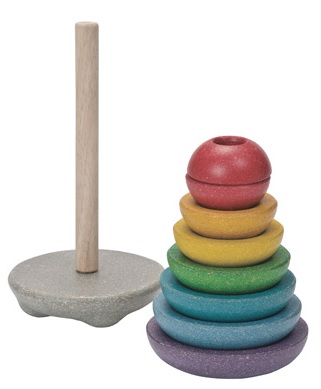
Instead, stacking rings (small enough for little fingers) with interesting textures, shape and color will be visually engaging, interesting to explore with fingers, mouth and feet (they will feel the edges, top, bottom, and explore the hole), allow stacking, banging, putting on and into (can put the rings in a wooden bowl or onto a wooden spoon handle), and provide opportunity for directed or interactive play with an adult or other child (that includes an action based conversation).
So what about those baby jumpers? I know most babies love them, and I’m not saying absolutely no. However, play in upright is about learning to control body mass and move with purpose. Early use of a baby jumper places infants upright, but controls their mass for them. They also restrain lateral mobility (creeping, crawling, rolling). Occasional use is fine, but it should be that- occasional. This same rule of thumb goes for baby minders (infant swings, seats, etc.). Be baby smart. While they are great tools in helping calm baby, getting them upright, and of course, allowing you to get to the toilet by yourself, their use should not be continuous.
There ARE some instances where these rules are less applicable (severe reflux, respiratory compromise, birth injury or orthopedic injury for example). If you are not sure, feel free to call me or send me a message. I am happy to help you get it figured out!
 MoveWelldotme
Leave a comment