Is early detection of cerebral palsy possible in preterm infants?
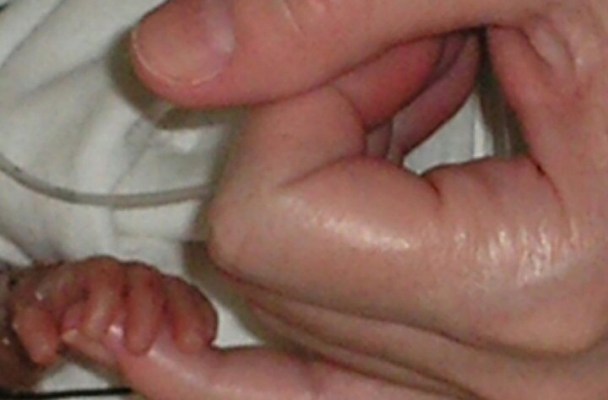
This is a tricky piece to write; not because of the content, but because of the emotion attached to it. No one wants their child to have cerebral palsy, and the diagnosis is probably almost as heartbreaking as the uncertainty. It is important to move forward and ask the question though, as obtaining an answer gives you a place to start in providing your baby with help. No amount of waiting will change the damage that was already done. Early intervention, on the other hand, can help maximize neuronal connections and improve outcomes. A diagnosis of cerebral palsy does NOT mean a life without potential. Thankfully, things have changed a lot in the past few years! I want to encourage parents to take what may seem like a leap of a step, and know that they are not alone on the roller coaster.
Ask questions. Keep asking questions.
Is early detection possible? In a large number of infants the answer is YES. A team of pediatric neurologists in Europe spent years on this question and developed a tool to do just that. Their result, the Prechtl Assessment of General Movements, is a highly reliable, valid, and sensitive test that has been in use for several years throughout Italy, France, Germany and the UK, as part of a routine NICU high risk screening protocol. It is specifically for children born prematurely, starting at 26 weeks gestational age, and can be used up to 3 months corrected age. It is also predictive of later problems in this population. It is relatively easy to do, but takes a fair amount of training and practice to be proficient. The Prechtl simply provides a way to assess the movement of infants when they are in a calm, alert and awake state. The variety, quality and quantity of movement is recorded on at least two occasions, and is carefully noted. Consistently similar scoring helps generate a conclusion and predict underlying motor difficulties.
So far, the Assessment of General Movements has been used in infants who have experienced some sort of neonatal brain injury, in Rhett’s syndrome and in infants with a myelomeningocele.
It is not unusual for me to speak with very worried parents, who are anxiously ticking off the days in some sort of holding pattern, while waiting for a definitive answer. They may have paid for expensive developmental tests and been left with mixed conclusions, or told just to continue to wait and see. While the wait and see answer might truly be the best one at the time, it isn’t always. It frustrates me, and I think we can and should do better here in the United States. The growing brain in an infant has the most potential for the repair, formation and support of neuronal connections very early in life. While this plasticity continues though adulthood, there are critical windows of development. Waiting means letting these windows pass without fully using the potential they may hold. Again, the answer is YES.
Bibliography
Fetal and infant spontaneous general movements as predictors of developmental disabilities. Zuk L. Dev Disabil Res Rev. 2011 Nov;17(2):93-101. doi: 10.1002/ddrr.1104. Review.
The predictive validity of general movements–a systematic review. Burger M, Louw QA. Eur J Paediatr Neurol. 2009 Sep;13(5):408-20. doi: 10.1016/j.ejpn.2008.09.004. Epub 2008 Nov 25. Review.
Predictive value of neurodevelopmental assessment versus evaluation of general movements for motor outcome in preterm infants with birth weights <1500 g. Stahlmann N, Härtel C, Knopp A, Gehring B, Kiecksee H, Thyen U. Neuropediatrics. 2007 Apr;38(2):91-9. G
eneral movement assessment: predicting cerebral palsy in clinical practise. Adde L, Rygg M, Lossius K, Oberg GK, Støen R. Early Hum Dev. 2007 Jan;83(1):13-8. Epub 2006 May 2.
Spontaneous motor activity three months after birth in comparison with clinical and ultrasound studies. Ivanov IS, Shukerski KG, Chepisheva EV. Folia Med (Plovdiv). 2005;47(2):18-23.
Does a detailed assessment of poor repertoire general movements help to identify those infants who will develop normally? Nakajima Y, Einspieler C, Marschik PB, Bos AF, Prechtl HF. Early Hum Dev. 2006 Jan;82(1):53-9. Epub 2005 Sep 8.
Prechtl’s assessment of general movements: a diagnostic tool for the functional assessment of the young nervous system. Einspieler C, Prechtl HF. Ment Retard Dev Disabil Res Rev. 2005;11(1):61-7. Review.
General movements detect early signs of hemiplegia in term infants with neonatal cerebral infarction. Guzzetta A, Mercuri E, Rapisardi G, Ferrari F, Roversi MF, Cowan F, Rutherford M, Paolicelli PB, Einspieler C, Boldrini A, Dubowitz L, Prechtl HF, Cioni G. Neuropediatrics. 2003 Apr;34(2):61-6.
The early markers for later dyskinetic cerebral palsy are different from those for spastic cerebral palsy. Einspieler C, Cioni G, Paolicelli PB, Bos AF, Dressler A, Ferrari F, Roversi MF, Prechtl HF. Neuropediatrics. 2002 Apr;33(2):73-8.
Cramped synchronized general movements in preterm infants as an early marker for cerebral palsy. Ferrari F, Cioni G, Einspieler C, Roversi MF, Bos AF, Paolicelli PB, Ranzi A, Prechtl HF. Arch Pediatr Adolesc Med. 2002 May;156(5):460-7.
General movement assessment as a method of developmental neurology: new paradigms and their consequences. The 1999 Ronnie MacKeith lecture. Prechtl HF. Dev Med Child Neurol. 2001 Dec;43(12):836-42. Review. No abstract available.


Leave a Reply